
GSAM: How quant strategies drive the alpha-enhanced approach to equity investing

Today’s equity markets are more diverse and challenging than ever. This has created structural advantages for an alpha-enhanced approach to equity investing, which seeks to deliver alpha stability and consistency while balancing portfolio risks.
By Hania Schmidt, Head of QIS in EMEA and Global Co-Head of Client Portfolio Management for QIS, and Frederik Templiner, Co-Head of Quant Equity Client Portfolio Management, Quantitative Investment Strategies, both at Goldman Sachs Asset Management
We think a quantitative – systematic and data-driven – stock-selection process is the most effective way to implement an alphaenhanced approach, particularly in complex and inherently inefficient markets. The combination of an alpha-enhanced approach powered by a quant engine can offer investors a low correlation to traditional managers, limit macro biases, and construct diversified portfolios, all with the aim of optimizing returns without uncompensated active risk. We believe these advantages provide a strong argument for deploying alpha-enhanced strategies at the core of institutional public equity portfolios.
Diversification driven by the scalability of systematic investing
Alpha-enhanced investment strategies work by taking a large number of small active bets across market caps, sectors and geographies in a diversified manner, aiming to limit concentration, avoid unintended risk exposures, and maintain a composition that is close to the benchmark. The goal of this approach is to seek alpha stability and consistency while balancing portfolio risks. These strategies are built to deliver on three main objectives:
- Consistent positive performance over the long term;
- Alpha efficiency tied to the tendency for potential risk-adjusted outperformance to be highest at lower levels of tracking error;
- Risk balance potentially achieved by holding a larger number of names than strategies with a high active weight, and by tracking their benchmarks more closely.
To achieve these objectives, alpha-enhanced strategies incorporate a versatile alphaseeking component that is controlled and risk-managed, potentially allowing investors to use their portfolio risk budgets more efficiently. These strategies’ tracking-error budgets are set in line with investors’ risk appetites but tend to fall in a range of 50 to 200 basis points. The added risk gives portfolio managers scope to improve riskadjusted returns by overweighting or underweighting stocks based on forwardlooking, stock-specific views.
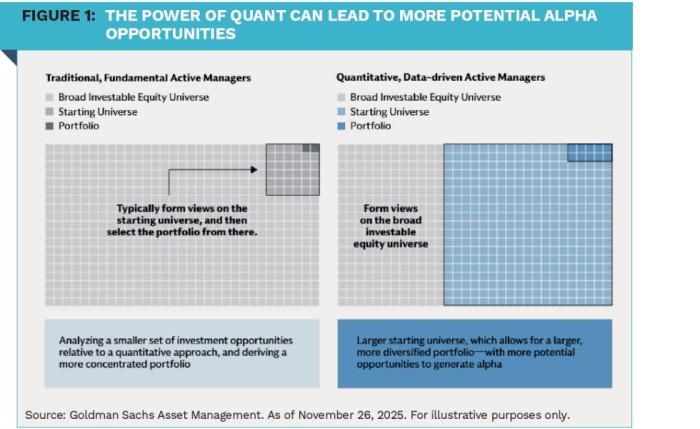
In practice, this necessitates a systematic investment approach capable of covering the full scope of an equity universe at scale, even in complex and less efficient markets. To achieve this, quant strategies consolidate fragmented data into a single, actionable picture, enabling consistent application of an investment strategy across market segments. In our view, this is only possible thanks to the scalability of the systematic approach. This scope at scale allows quantdriven alpha-enhanced strategies to take a large number of positions, which may enable diversification in line with the benchmark and efficient tracking-error management.
We think this breadth of coverage is a significant advantage for quant managers because it allows them to apply their investment theses across a broad universe of securities. This results in strategies capable of generating excess returns without taking on significant levels of active risk even in a long-only implementation.
Alpha generation through changing market environments
Quant strategies can add dynamism to an equity portfolio, allowing effective adaptation to changing market conditions. This ability to react swiftly to new information enables more frequent rebalancing and continuous evaluation of potential risks and alpha opportunities. Frequent rebalancing is necessitated by a strategy focused on small active bets along the benchmark in pursuit of consistent alpha. A nimble approach is also needed to navigate heightened market volatility, especially for strategies that seek to control risks.
Quant strategies’ active equity positions tend to nimbly adjust over time
Alpha-enhanced strategies tend to rely on diversified return and risk drivers in pursuit of idiosyncratic excess return. Thanks to this adaptability, systematic approaches can remain structurally independent of specific factors or styles. By leveraging alternative data sources, these strategies can target structurally different alpha to retain the diversification that supports alpha consistency.
To maintain a style-pure, macro-agnostic profile, alpha-enhanced strategies tend to focus on stock-specific information, intentionally reducing the risks inherent in more top-down, macroeconomic considerations as well as biases related to country, sector or style. This ensures exposure to market beta with a tight focus on risk management through market cycles and periods of volatility while maintaining the ability to exploit investment opportunities. The majority of stocks in a diversified alpha-enhanced strategy are chosen based on longer-term factors, but the rest of the portfolio is nimble enough to take advantage of shorter-term drivers of return, like sentiment-based factors and a certain degree of momentum.
A comparison of the annual returns of common factor indices with those of the MSCI World Index shows that investment styles can be hit or miss over time. A factor that drives outperformance one year may underperform the next. This highlights the value of a style-pure approach for systematic strategies designed to generate alpha consistently year after year.
Relative calendar year returns of common factor indices versus MSCI World Index
The idiosyncratic nature of excess-return drivers in alpha-enhanced strategies can be seen through the typically low correlation among quant managers and their even lower correlation with fundamental managers. This low correlation enhances diversification and portfolio resilience in market downturns. For example, analyzing the monthly excess returns correlation among managers in the eVestment global largecap equity space, we found that the median correlation among all quant managers in the space was 0.11, and that of quant managers versus fundamental managers was as low as 0.02.[1] This highlights the structural advantage of systematic investing in building the portfolio resilience needed to generate consistent alpha.
The case for quant at the core of equity portfolios
We believe there is a strong case for placing strategies built on data-driven, systematic stock selection, such as alpha-enhanced, at the heart of institutional public equity portfolios. This approach to portfolio construction can enable the disciplined deployment of active risk while retaining market beta. We believe that quant managers are well positioned to realize the potential of alpha-enhanced, especially those with the capacity to deploy data and technology at sufficient scale across investment universes and the expertise to manage risk effectively across markets. A focus on research and innovation is also required to allow quant managers to retain the edge that potentially generates consistent returns over the long term, in our view.
[1] Goldman Sachs Asset Management, eVestment. As of July 29, 2025. The data represent the correlation of monthly excess returns among quant and fundamental managers in the global large cap equity universe in eVestment for the time period based on data availability, Returns measured in USD and measured against the manager-preferred benchmark. Passive managers were excluded from the analysis.
|
SUMMARY Alpha-enhanced strategies aim to deliver stable, consistent alpha while closely tracking benchmarks and controlling risk. Quantitative, data-driven processes enable scalable stock selection across broad and complex equity universes. Diversification is achieved through many small active bets, limiting concentration and unintended exposures. These strategies adapt dynamically to changing market conditions through frequent rebalancing and alternative data. Low correlation with traditional managers enhances portfolio diversification and resilience. |
Read the article in Financial Investigator magazine