
Columbia Threadneedle: LDI 2.0 - three trends that are redefining matching portfolios

This article was originally written in Dutch. This is an English translation.
Now that the dust has settled on the first wave of the Wtp transition, the outlines of a new generation of LDI strategies are emerging, with a different focus than usual. Three trends are currently influencing the development of matching portfolios.
By Jan Willemsen, LDI Client Portfolio Manager, Columbia Threadneedle Investments
Trend 1: Reserve portfolios – from implicit to explicit
Under the FTK, the total portfolio acted as a buffer against all risks. After all, members’ assets, reserves and provisions were invested collectively. When interest rates moved, everything moved with them. Under the Wtp, that luxury has disappeared. The collective buffer capital, or the risk fund – consisting of MVEV, cost provisions, the Operational Risk Reserve and PVI provisions – now stands alone. Each component requires its own approach.
Practice shows two main approaches. Some pension funds opt for the pragmatic route: aligning reserve portfolios with an older age cohort from the lifecycle. This is administratively simple, but offers little scope for customisation. Other funds set up the risk fund separately. This requires more governance, but does offer more scope for customisation per component.
That precision pays off. The cost provision is subject to both nominal interest rate risk and inflation risk. For the nominal component, a combination of LDI funds across the curve and money market funds offers an accurate, cost-efficient solution. In addition to the components within the risk fund’s assets, some pension funds set up separate compensation accounts with the aim of compensating members who suffer a disadvantage as a result of the transition. For these accounts, cash flow matching with high-quality bonds is the obvious choice: bond cash flows match benefit cash flows within 5%, supplemented by money market funds for liquidity.
Inflation risk deserves particular attention. Many funds value provisions without an inflation component, which creates a hidden financing risk. Inflation-linked swaps are the most suitable hedge. The European inflation-linked bond market is, in fact, too thin: there are no new German issues, the average duration is four years, and southern European countries with lower-than-usual ratings dominate the matching portfolios. This teaches us that the WTP requires explicit choices for each component.
Trend 2: New composition of the liquid matching portfolio
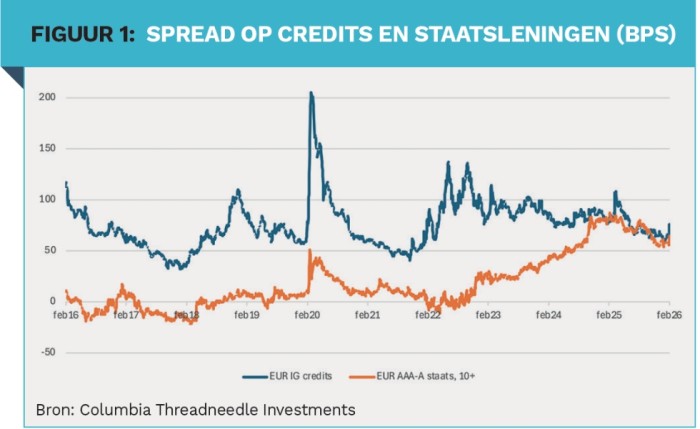
For years, the liquid matching portfolio rested on two pillars: interest rate swaps and government bonds, supplemented by SSAs and covered bonds. That composition is coming under pressure. Spreads on corporate bonds are low. Whilst government bonds are significantly more attractive than three years ago, they are also riskier. The situation in France illustrates the vulnerability: political fragmentation and downgrades to A+ have led to widening spreads. Budget deficits remain high in Europe due to defence spending, and the number of European AAAAA-rated countries is low. As an alternative, one could look to countries where the rating is improving (such as Spain) and to non-European government bonds with high credit ratings.
At the same time, DNB is placing greater emphasis on mismatch risk. Pension funds are therefore seeking ways to manage spread risk without weakening interest rate hedging. Three potential solutions are emerging. There is also a demographic driver.
An increasing number of pension funds are ageing and becoming cash-flow negative, meaning that pension payouts exceed premium income. Often, lifecycle strategies also employ a high return weighting. The result is that the matching portfolio both finances the outflows and provides interest rate hedging using leverage.
- Firstly: shortening the credit portfolio. Longer maturities with spreads make positions riskier. A shift towards shorter credits reduces the tracking error relative to swap rates.
- Secondly: geographical diversification. Global short-term credits offer greater diversification and liquidity. Concentration risk decreases, whilst returns remain on a par with those of a longer-duration credit portfolio.
- Thirdly: securitised assets. The market for asset-backed securities offers attractive spreads on shorter maturities, high liquidity and AAA ratings. The US market is substantially larger than the European one and offers greater diversification opportunities.
A buy-and-hold strategy for credits fits this perfectly. By holding bonds to maturity and harvesting coupons for liquidity management, an additional source of liquidity is created. This is also known as cash-flow-aware investing. It reduces the need to liquidate positions at unfavourable times and improves collateral management. The focus shifts from benchmark-index-driven management to a benchmark-index-agnostic approach, in which coupon payments and redemptions are explicitly used to meet cash flow requirements.
Trend 3: Volatile cash flows and the delivery gap
Under the WTP, cash flows move in line with the market on a month-to-month basis. High returns in the return portfolio lead to higher nominal cash flow projections, causing interest rate hedging to decrease. Rising interest rates have the same effect.
This volatility introduces a new risk: the delivery gap. The mechanism works as follows: at month-end, returns are allocated to the cohorts. The pension administrator calculates the new asset values and cash flows, which are shared with the LDI manager a few weeks later. During that period, interest rate hedging does not take market developments into account. This creates a risk of a deviation between the protected return and the realised matching return.
An initial live test covering 2025 shows that the potential deviation could amount to 0.25% of total fund assets. That may not seem like much, but market conditions were not particularly volatile at the time.
Two solutions are effective. A clear mandate is crucial: is the LDI manager permitted to act on the basis of the proxy, and how and when should action be taken? The choice of bandwidth is also important. A backtest covering a five-year period shows that a bandwidth of 1% leads to monthly rebalancing, and 5% to quarterly rebalancing. In practice, bandwidths of 3–5% are common, with the trade-off between costs and accuracy being the determining factor.
- Firstly: minimise the delivery gap itself by shortening the period between month-end and settlement.
- Secondly: work with proxy cash flows that incorporate current market developments. This provides real-time monitoring of the hedge ratio and a tool to manage the mismatch.
Outlook
Together, these three trends outline the contours of LDI 2.0. Whereas the first generation focused on efficient interest rate hedging with minimal governance, the new generation calls for granularity in risk management, flexibility in the choice of instruments, and proactive monitoring. Pension funds wishing to navigate the new system successfully would do well to embrace these trends.
|
SUMMARY The Wtp creates differentiated reserve portfolios that require explicit hedging via LDI funds, cash flow matching and inflation-linked swaps. Liquid matching portfolios are shifting towards shorter-term credits, geographical diversification and securitised assets to manage spread risk. Ageing funds are becoming cash-flow negative, necessitating buy-and-maintain strategies. Volatile cash flows and delivery gaps require proxy monitoring and clear mandates for effective mismatch manage |