A lack of risk appetite in Europe
This report was originally written in Dutch. This is an English translation
The institutional sector could do more to finance Europe’s strategic transitions. Europe is a continent of savers, with a structural current account surplus of 2% to 3% of gross domestic product. Unfortunately, too little of this goes towards risk-bearing assets.
By Hans Amesz
|
Chair Arjen Pasma, Chief Investment Officer, PGGM
Participants Yorick Cramer, Sector Manager for Industry & Defence, Rabobank Klaas Knot, Former President of De Nederlandsche Bank, Former Chair of the Financial Stability Board, Professor of Money and Banking, University of Groningen Ronald Wuijster, Former CEO, APG Asset Management |
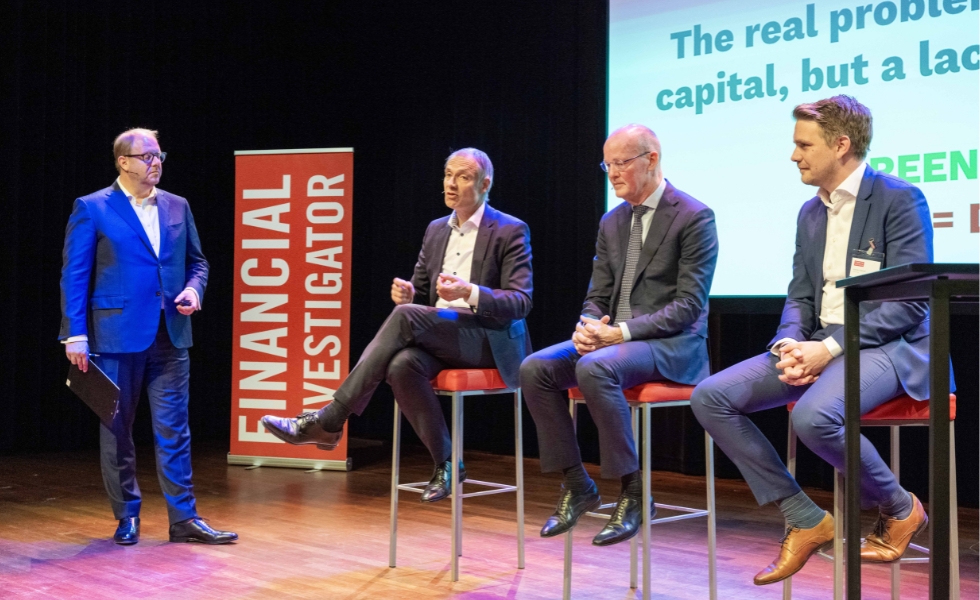
During the seminar on the future of Europe organised by Financial Investigator, chair Arjen Pasma engaged in a discussion with Klaas Knot, Ronald Wuijster and Yorick Cramer, using a series of propositions to explore the strategic transitions Europe must undergo to become more resilient, and the role of institutional capital in this process.
Proposition 1: The real problem in Europe is not a lack of capital, but a lack of risk appetite.
Ronald Wuijster: ‘I agree that it is probably more about risk appetite than capital. There is plenty of capital available, but not everywhere. In certain segments, there is a degree of market failure, particularly in the phase immediately before and immediately after venture capital. In the phase before that, I don’t think much capital is available. And in the phase after that, when you’re scaling up, there generally isn’t enough risk appetite. The Dutch have a significant equity stake in their pension funds. But even pension funds are heavily regulated and risk-averse, which makes it difficult for them to adopt a long-term vision. In a sense, that makes sense. The supervisory boards are a sort of mini-parliament, with all sorts of perspectives and checks and balances, making it difficult in practice to always proceed with long-term investments, despite the fact that, according to formal theory, pension funds are supposed to be long-term investors. Throughout my career, I have argued that if you were to combine the optimal investment mixes for the life cycles of all individuals, you would likely end up with a much higher equity allocation in pension funds than we see today. So yes, even there, I believe there is too much risk aversion.’
So pension funds need to take on more risk?
Wuijster: ‘A little more risk. Of course, there is exposure to equities, both listed and unlisted. So yes, there are long-term investments, there is a willingness to develop infrastructure and the venture sector, and there is a willingness to provide support. But that does not alter the fact that the pension fund sector could do a little more, though I am not saying we should go to the other extreme.’
Klaas Knot: ‘You can always debate whether Dutch pension funds should take on more risk and invest more in equities. I do believe, incidentally, that pension reform will better enable the funds to do so, as there will be far more age-dependent investments now that a lifecycle investment policy is becoming more feasible. But if we could first persuade all other European consumers to hold at least the same equity exposure as is implicitly embedded in the current Dutch pension system, the world would look considerably better in terms of the depth of capital markets, the availability of risk-bearing capital, and so on. I view these matters from a macroeconomic perspective. Europe is a thrifty continent, with a structural current account surplus of 2% to 3% of gross domestic product. There is therefore an abundance of savings, which is why I agree with the proposition. Unfortunately, too little of this ends up in risk-bearing assets. Too much goes into overly safe assets such as bank accounts. Safe assets are fine if you need the money in the very short term. But if you’re saving for thirty, forty or fifty years for your pension, why wouldn’t you take advantage of the equity risk premium, the illiquidity premium, and so on. So yes, it is indeed a lack of risk appetite.’
Proposition 2: Europe’s failure to direct capital is a systemic flaw.
Yorick Cramer: ‘I agree with this proposition, but disagree with the previous one. There is plenty of capital in Europe. We have pension funds, insurers and banks, and they are all willing to invest in strategic projects, even in defence. But financial institutions are not speculators; they are looking for projects that generate predictable income and cash flows. That, I think, is one of the problems. For example, if a company operates primarily in defence, it often has only one or two customers, namely ministries of defence. What I’m seeing now is that they don’t offer long-term commitments or long-term purchase agreements. The defence industry itself isn’t necessarily risky, because there is structural demand. We simply fail to translate that into those purchase agreements. If you offer them, you create clarity. So it is not even about risk aversion, but about risk clarity: what are the risks and can you quantify them? That is why I disagree with the first proposition.
In certain segments, there is a degree of market failure, particularly in the phase immediately before and after venture capital.
As for Europe’s failure to direct capital, I do think there is a systemic flaw, but it extends beyond the capital market. It is also about having a European industrial policy. We need coordination, because without it you end up with many smaller projects scattered across Europe, which creates uncertainty. With coordination, you can create large, meaningful projects that generate predictable revenue, become ‘bankable’ and ultimately attract capital.’
What is the main reason that private capital is not currently flowing into certain sectors, such as the defence sector? Or is that not a problem?
Cramer: ‘We have seen that the relationship between financial institutions and the defence industry has not always run smoothly. Until about four years ago, the headlines were full of stories about weapons falling into the wrong hands and who had financed them. As a result, banks and other financial institutions were reluctant to be associated with potential human rights violations and generally kept their distance from the defence industry. But then Russia invaded Ukraine and society as a whole realised that peace cannot be taken for granted and that a strong defence is needed to maintain it. Now we see that many financial institutions are willing and able to finance defence companies, provided there are sound business cases.’
Knot: ‘One systemic flaw has not yet been addressed. That is the fact that some countries, implicitly or explicitly, have decided that protecting their national defence industries is more important than exploiting the synergies of EU-wide defence procurement and investment. The Draghi report advocates an industrial policy, but at European level. Unfortunately, a number of leading EU countries have decided that protecting their own industries is more important. That is why we will not see any EU-wide initiatives for the time being. We will see coalitions of the willing, which, incidentally, is still an improvement on doing the same thing twenty-seven times over. You cannot always get all twenty-seven countries on board, but I think you need to bring together the six or seven largest countries in Europe. Then a large proportion of the rest may well follow.’
Proposition 3: Defence investments are a legitimate part of ESG. It should therefore be perfectly acceptable to invest in the defence industry.
Wuijster: ‘What does ESG actually mean in this context? Investing in ammunition or submarines isn’t really ESG, but investing in security and resilience probably is. I’m certainly not saying you should never invest in something if it isn’t ESG. But there are other elements that I believe do fit within the ESG sphere, particularly if they contribute to security. That includes IT security, radar technology, elements of quantum computing and investments in property related to defence.’
There is plenty of capital in Europe. But financial institutions aren’t speculators; they’re looking for projects that generate predictable income and cash flows.
Cramer: ‘If you add an extra S, you get ESSG – including safety – and then it makes sense. I don’t think ESG and defence investments are opposites anymore. What I do want to emphasise is that we, as a bank, have a role to play in ensuring that the financial system is not used for fraud, money laundering or human rights violations. I think there are still things we cannot do. We cannot finance controversial weapons; we will not finance companies that supply weapons to controversial regimes or weapons that are used in a controversial manner.’
What can be said about dual mandates for pension funds and the ECB?
Knot: ‘Much is said about the fact that the Fed has a dual mandate – inflation and growth – whilst the ECB has only an inflation target and perhaps should also have a growth target. But in this context, actions speak louder than words. If you look at the actual implementation of monetary policy, the difference between the Fed and the ECB is very small. Take, for example, the inflation period 2021–2025. Inflation remained above the 2% medium-term target for four years, which we generally interpret as one and a half to two years, as that is the horizon within which policy is effective. So one might ask why we kept inflation above the target for four years. Couldn’t we have brought it back down within two years? The answer is: yes, we could have. But the costs would have been enormous. We would not have had to raise interest rates to 4%, as we did, but perhaps as high as 10%. That would have stifled the economy and unemployment would have risen sharply. In practice, therefore, we already take into account the broader effects of monetary policy on growth and unemployment.’
There is an abundance of savings in Europe. But unfortunately, too little of it is channelled into risk-bearing assets.
Wuijster: ‘I think many of these objectives can go hand in hand. Many ESG factors are useful in assessing risks and evaluating long-term return potential, for example through an analysis of stranded assets or by identifying opportunities for innovation. In that sense, they complement each other well. One element – investing domestically – is more difficult in that context. But we must also recognise that investing domestically is quite normal for most countries. Many funds have a certain degree of home bias. As investment professionals, we are often taught to avoid a preference for our own country. I remember being told at the start of my career to avoid ‘not in my backyard’ issues, that domestic investments could cause complications. But I think we are one of the few countries where this approach has been applied so strictly.
It might be worth taking a step back and realising that members need to be able to recognise their pension funds’ investments. That need not have a major impact on returns. These always fall within a certain range. That offers some leeway. Within that range, it is possible to make investments more recognisable to members, which could introduce a modest preference for one’s own country. As long as this does not go too far, I see nothing wrong with it. And ‘home’ can mean both the Netherlands and Europe in this context. Personally, I identify strongly as a European, perhaps even more so than simply as a Dutch person, but in practice it is both.’
|
SUMMARY If you were to combine the optimal investment mix for the life cycles of all individuals, you would likely end up with a much higher equity allocation in pension funds than we currently see. There is a surplus of savings in Europe, very little of which is channelled into risk-bearing assets. Many financial institutions are willing and able to finance defence companies, provided there are solid business cases. You cannot always get all twenty-seven EU countries on board, but you do need to be able to bring together the six or seven largest countries in Europe. Then the vast majority of the rest may well follow. |