
Achmea IM: Infrastructure, from inflation hedge to strategic necessity

This article was originally written in Dutch. This is an English translation.
The energy transition, geopolitical tensions and the resurgence of inflation risks have placed infrastructure more firmly on the agenda of institutional investors. Whilst the sector was long viewed primarily as a source of stable cash flows, it is increasingly regarded as a strategic building block. At the same time, the transformation of the energy system requires large-scale investment in networks, storage capacity and flexibility solutions. What does this new reality mean for pension funds and insurers?
By Ruben Kwast, Investment Strategist, and Harry van den Heuvel, Senior Portfolio Manager Infrastructure, both at Achmea Investment Management
Why is infrastructure currently attracting such significant attention from institutional investors?
Infrastructure has already been a major focus of attention in recent years due to the energy transition, but has come even more to the fore as a result of increased geopolitical uncertainty. The discussion is no longer solely about sustainability, but also about energy security, economic resilience and reducing vulnerable dependencies. The recent tensions in the Middle East have once again highlighted just how sensitive global energy flows are to geopolitical shocks. For Europe, this means that access to reliable, affordable and sustainable energy has become an even more pressing strategic issue.
In addition, institutional investors are re-evaluating the structure of their portfolios. The era of very low interest rates is behind us, inflation risks have returned, and traditional diversification between equities and bonds is less self-evident than in the past. In this context, infrastructure can be an attractive option, as the asset class can combine long-term cash flows, partial protection against inflation and exposure to structural investment challenges. This makes infrastructure relevant not only from a societal or thematic perspective, but also in terms of portfolio construction.
It is also interesting to note that, for a long time, a traditional real assets portfolio consisted mainly of property, possibly supplemented by a limited allocation to infrastructure. Given current developments, the question is increasingly being asked as to whether infrastructure should play a greater role within real assets portfolios. It is no longer just a matter of a thematic investment in the energy transition, but of a broader building block that can contribute to more robust portfolios, protection against inflation and the financing of essential economic infrastructure. At the same time, this calls for selectivity: not every infrastructure investment automatically offers stable cash flows or protection against inflation.
What role does the energy transition play in this development?
The energy transition is often seen as simply a matter of building wind and solar farms, but that view is now outdated. We are facing a much broader transformation of the energy system.
Access to reliable, affordable and sustainable energy has become an even more pressing strategic issue for Europe.
The rapid growth of renewable energy means that huge investments are needed in electricity grids, interconnections, energy storage and flexibility solutions. Batteries are playing an increasingly important role in this, as they help to offset fluctuations in wind and solar energy production, reduce peak demand and utilise the grid more efficiently. In addition, the electrification of transport, industry and buildings is leading to a structurally higher demand for electricity. This is compounded by new energy-intensive applications, such as data centres and AI-related infrastructure.
The focus is therefore shifting from mere generation capacity to the infrastructure that underpins the entire energy system. For investors, this opens up a wide range of investment opportunities, with network operators, battery storage, storage facilities, interconnections and other regulated or contractually supported infrastructure set to play an increasingly important role.
Infrastructure is often cited as a hedge against inflation. Is this justified?
Yes, but only if this assertion is approached with nuance. Not all infrastructure offers the same degree of protection against inflation, and the investment horizon is also a determining factor.
In the short term, infrastructure is not a direct hedge against inflation, as commodities can be. Inflationary shocks often have a delayed impact on cash flows, for example through contractual indexation. Furthermore, an environment of rising inflation may be accompanied by higher interest rates, which could put pressure on valuations.
In the longer term, the picture is more favourable. Our own research shows that unlisted infrastructure actually correlates more strongly with inflation over longer investment horizons. This is because many infrastructure assets have regulated tariffs, long-term contracts or explicit inflation indexation. In such cases, rising costs can be passed on in part or in full, thereby better preserving the real value of cash flows. Infrastructure is therefore less suitable as a hedge against acute inflationary shocks, but can contribute to preserving real cash flows within an institutional portfolio in the longer term.
At the same time, this does not apply to all segments of infrastructure. In more market-driven projects, such as certain toll roads or energy projects with merchant exposure, revenues may be more heavily dependent on demand trends, market prices or operational costs. Inflation protection is less self-evident in such cases and depends heavily on the contract structure, tariff agreements, financing and market conditions.
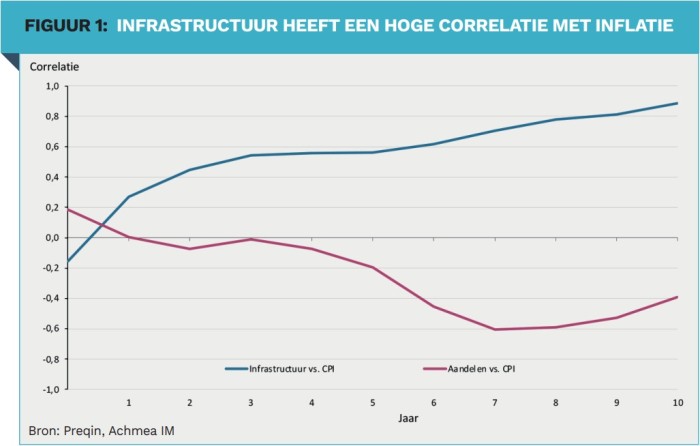
Investors must therefore look beyond the ‘infrastructure’ label alone. The distinction between regulated and contractual assets and more market-driven projects is essential to the portfolio’s ultimate inflation profile.
How significant is the investment challenge facing Europe?
That challenge is enormous. The European energy system must be radically modernised and expanded over the coming decades. The European Commission estimates that around €660 billion in annual investment will be required for clean energy by 2030. This order of magnitude is also in line with the Draghi report, which emphasises the broader European investment challenge relating to competitiveness, sustainability, digitalisation and security.
Public funds alone will not be sufficient to meet this challenge. Institutional capital will therefore have to play a key role in financing the energy transition. This aligns well with the characteristics of pension funds and insurers. They have long-term liabilities and are specifically seeking long-term investments with relatively predictable cash flows.
However, the scale of the investment challenge does not mean that every project is automatically attractive. Governance, contract quality, implementation risks and regulatory stability remain crucial factors. Ultimately, it is not just about the amount of capital that becomes available, but also about the investability of projects.
What role can infrastructure play within an institutional portfolio?
Infrastructure can fulfil several functions simultaneously within an institutional portfolio. The asset class can help achieve impact objectives, contribute to stable long-term income, provide diversification relative to equities and bonds and, depending on the underlying assets and contract structures, offer protection against inflation risks in the longer term.
In our analysis, we examined what happens when an equity portfolio is partially supplemented with various asset classes, such as private equity, hedge funds, property and infrastructure. Infrastructure emerged as the strongest performer. Within the assumptions used, the asset class demonstrated a favourable combination of expected return, volatility and correlation with other investments. Particularly because infrastructure has different risk drivers to listed shares, a partial allocation contributes to a better-diversified portfolio. As such, infrastructure is not a substitute for shares or bonds, but a complementary building block that can help to make portfolios more robust.
Infrastructure is not a substitute for shares or bonds, but a complementary building block that can help make portfolios more robust.
For many institutional investors, this is an important feature. Traditional bonds do not always offer sufficient protection against inflation, whilst equity portfolios remain vulnerable to economic shocks. Infrastructure can therefore act as a complementary building block with characteristics different from those of traditional equities and bonds.
How can investors best incorporate infrastructure into their portfolios?
For the core of an infrastructure allocation, broadly diversified open-ended infrastructure funds are often preferred. These funds offer efficient access to the asset class’s beta, are generally well diversified, and align well with institutional investors in terms of scale, continuity and long-term horizon. At the same time, this approach also requires attention to valuation, liquidity management and the quality of the underlying portfolio.
In addition, there may be a complementary role for closed-end funds focusing on core-plus or value-add strategies. These funds are often better suited to targeting specific themes or segments, such as climate, energy transition, sustainability or digital infrastructure.
In this context, the importance of active ownership is growing. Returns in such segments are determined not only by the macro trend of the energy transition, but also by project execution, operational management, financing structure and the quality of external managers.
Discipline therefore remains at the heart of successful infrastructure investment. In a world where energy security, inflation and geopolitics are becoming increasingly intertwined, it ultimately comes down to selecting assets with strong contracts, robust regulation and predictable real cash flows. As a result, infrastructure becomes not only a source of returns, but also a strategic building block for the portfolio of the future.
|
SUMMARY Geopolitics, energy security and the energy transition are increasing the strategic significance of infrastructure. Investments are shifting from energy generation to networks, storage, interconnections and digital infrastructure.Institutional capital is essential to finance this investment challenge. Selectivity remains crucial: contract quality, regulation, governance and execution risk determine the outcomes. |
|
Disclaimer Investing involves risks and costs. This is a promotional communication. This information is intended solely for professional investors, has been compiled with care, and does not constitute an offer or invitation to buy, sell or trade financial instruments, nor does it constitute an investment recommendation or investment advice, nor does it constitute legal or tax advice. The value of your investments may fluctuate, and past performance is no guarantee of future results. Your return depends on how the market performs and how long you hold the investment. Achmea Investment Management B.V., as a manager of investment funds, is registered with the AFM. |
Read the full article in the digital magazine