
Harry Geels: Put an end to the left-right framework (part 1)

This column was originally written in Dutch. This is an English translation.
By Harry Geels
I have repeatedly argued that the current left-right framework is intellectually shallow and unnecessarily polarising. This time, I shall support this argument by describing the diversity on the ‘right’.
A short video is circulating online in which the Argentine President, Javier Milei, says that a company can pollute a river as much as it likes. Milei’s opponents see this as an example of how harmful the ‘far right’ is to the climate. The clip comes from an economic conference in Argentina in September 2023, when Milei was still a presidential candidate. The first question is whether the video is a fair representation of his position; the second goes deeper, namely, what political ideology Milei espouses.
The crippling left-right framework
In previous columns, I have argued that the current left-right framework is flawed. Firstly, there is a wide diversity of political movements, which I have previously illustrated in the figure below, showing four quadrants of major political currents along two dimensions: nationalism <-> supranationalism and liberal <-> anti-liberal. The first dimension primarily concerns national borders and one’s own culture. The more sacred these are regarded, the more nationalist a political movement becomes. At the other end of the spectrum are political parties that are, in fact, globalist. They are open to other cultures and international alliances.
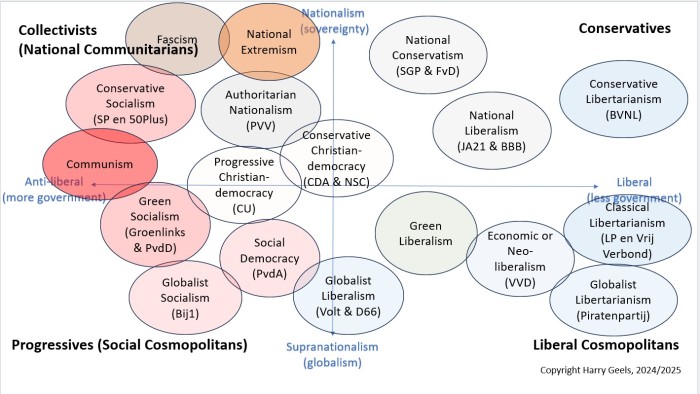
The second dimension mainly concerns the role of the state: communists regulate everything through the state, whilst libertarians wish to live as freely as possible, be self-reliant and leave as many matters as possible to the free market. The second reason why the left-right framework is detrimental relates to the changing nature of political movements. Who would ever have thought that socialist parties would now be in favour of major investment in the defence industry and would seek international trade and cooperation, whilst various conservative movements are becoming increasingly sceptical of precisely these things?
Then there is the third reason why I oppose the left-right framework: it polarises. We divide many parties into two camps, usually with an additional label such as the ‘dumb’ or ‘far right’ or the ‘elitist left’. This is not only polarising, but also intellectually impoverished. There are, in fact, many political movements which – although they appear to be close to one another – can nevertheless differ considerably. The figure above already shows many different types of movements. But it is actually far more diverse than that. In this column, I want to take a closer look at the right-hand quadrants.
Even more nuance
There are four movements that gain almost no traction in the Netherlands and which lie even further to the right than classical libertarianism (three of these are additions to the diagram above). Firstly, the classical libertarianism of Locke, Hayek and Friedman, which stands for individual freedom, the free market and limited government. The state protects property, contracts and the rule of law, and acts as the market regulator, primarily to ensure that when parties conduct business with one another, no harm is caused to third parties. Even further to the right lies minarchism, which advocates the ‘night-watchman state’: comprising only the police, defence and the judiciary. All other government functions are explicitly deemed illegitimate.
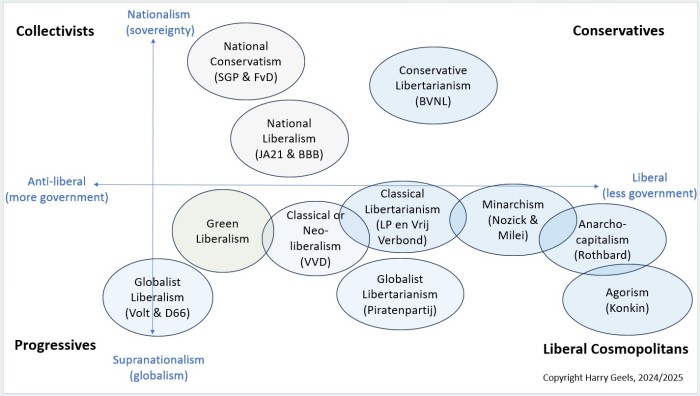
Milei has openly declared himself to be a minarchist – and indeed a radical one at that – by actively dismantling all ‘illegal’ government functions and bodies. Anarcho-capitalism (Rothbard) rejects the state entirely. The administration of justice, security and all public services are organised on a voluntary basis through the market. Agorism (Konkin) moves towards a stateless society via counter-economies: voluntary trade outside state control. Change comes through markets and parallel systems, not through politics.
Back to Milei and his quote
In Milei’s broader argument concerning ‘a company’s right to pollute a river’, he argued that pollution arises because there are no clearly enforced property rights. If no one owns a river, no one has a direct economic incentive to protect it. If it becomes scarce and property rights emerge (one of the core tenets of minarchism), owners would prevent pollution because it diminishes the value of their property. Consequently, he argues, the market would be better able to curb pollution than the state.
In other words, his broader point was not that pollution is good, but that clear property rights can reduce environmental damage. Milei seeks to solve the problem of the ‘commons’ through property rights. The major problem with the commons is that they belong to everyone and therefore to no one, meaning that damage to the commons can often go unpunished. Minarchism differs here from well-known libertarian thinkers such as Friedman, who do recognise that businesses and consumers can cause negative externalities for which they should pay, for example through emission allowances or environmental taxes.
Final thought
Whether Milei is right or wrong is not the main point here. What is relevant is that his ideas stem from a political tradition that differs fundamentally from both conservatism and classical liberalism. Yet in public debate, he is often simply dismissed as ‘right-wing’. This causes the substantive differences between diverse schools of thought to vanish behind a single catch-all term. It is precisely for this reason that the left-right framework falls short: it replaces analysis with labels. If we increasingly come to recognise the nuances, we can hopefully also counteract the rapidly growing emotional polarisation.
Next week: part 2 of the left-right framework, on the many currents within the left-hand quadrants, featuring a number of notable examples that are likely to demonstrate even more clearly that the left-right framework is intellectually impoverished.
This article reflects the personal opinion of Harry Geels