
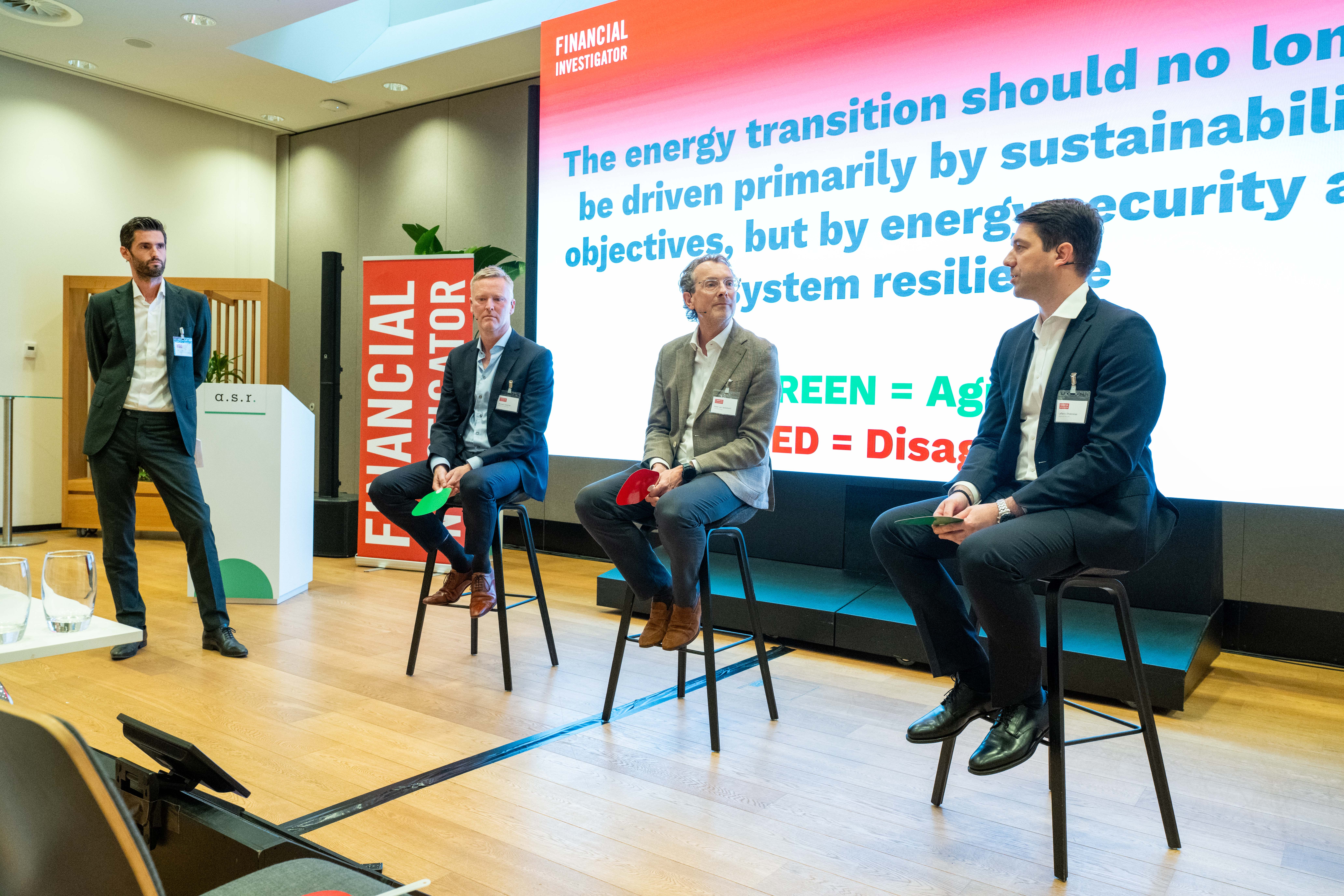
Panel discussion 'Infrastructure for the Energy Transition'
This report was originally written in Dutch. This is an English translation.
Due to electrification and grid congestion, the focus within the energy transition is shifting increasingly towards flexibility, storage and interconnectivity. What opportunities and risks does this systemic change present for investors?
By Hans Amesz
|
CHAIR Luc Joosten, Managing Director, a.s.r. real assets investment partners
PARTICIPANTS Peter van Apeldoorn, Founder, Transformergy Ronald Huisman, Professor of Sustainable Energy Finance, Erasmus School of Economics Lefteris Strakosias, Investment Director for Energy Transition, Gresham House |
Should the energy transition henceforth be driven primarily by energy security and resilience, rather than by sustainability targets?
Peter van Apeldoorn: ‘What I find interesting is that energy security and sustainability currently go hand in hand, to a greater or lesser extent. Energy systems and energy supply are becoming increasingly local: you have to ensure that your energy comes from nearby. Now that we are switching from molecules to electrons, energy supply is becoming local, and that also means greater energy resilience. You are no longer dependent on oil, which comes from far away.’
Lefteris Strakosias: ‘For me, it has always been about energy security and resilience. The transition in Europe to renewable energy was primarily driven by sustainability and decarbonisation targets, but there was also an energy security agenda at play. Thanks to policy support, it has been possible to create the investment framework and ecosystem needed to deploy renewable energy on a larger scale and improve its affordability. We are now entering the next phase of the transition, in which renewable energy generation must increasingly be complemented by flexibility and storage. I believe that an electricity system based on renewable energy and supported by flexibility can offer a solution to the energy trilemma of affordability, security of supply and sustainability. From my perspective, we are entering the age of electricity, in which our system is becoming increasingly electrified and decarbonised. I believe this is set to become the defining investment theme for the coming decade.’
Should the interconnection between different systems, networks, devices or organisations – in other words, interconnectivity – be viewed primarily as an opportunity or as a risk?
Strakosias: ‘That depends on which asset you own, its place within the energy system, and the extent to which it is subject to those interdependencies. Interdependencies have always existed within energy systems. The recent events in Iran are a good example. When oil and gas supplies are disrupted, this has immediate consequences for the entire energy system. The resilience of that system depends on sufficient flexibility and strategic reserves. In the oil and gas sector, this role has traditionally been fulfilled by oil storage capacity and strategic oil and gas reserves. The electricity grid is no different. Flexibility and reserve capacity are needed there too, but these services are increasingly being provided by facilities such as battery storage.’
Van Apeldoorn: ‘I am in favour of interconnectivity and also see it as an investment opportunity. But interconnections are very expensive and take a long time to build. If you can find plenty of local energy systems and solutions, you might not need all that interconnectivity.’
As a property investor, you should also consider: could my building itself be a kind of mini-energy system and generate additional cash flow?
How should investors deal with growing interconnectivity?
Ronald Huisman: ‘I think investors should approach this from a pan-European perspective. The definition of interconnectivity isn’t limited to countries alone; you can also look at it at a much more local level. I see interconnectivity as an opportunity, because we can benefit from a surplus of renewable energy, for example from another region. We import renewable hydropower from Norway. This therefore increases our exposure to renewable energy. But there is also a risk. Interconnectivity, for example, led to problems when there was a power cut in France a few years ago. We felt the knock-on effects of that here too. And that will happen not only on a larger scale, but also on a smaller one. It means that, within your local system, you must always have the flexibility to deal with those knock-on effects. On the other hand, interconnectivity offers opportunities to benefit from flexibility and from renewable energy available elsewhere. I think you can capitalise on this from an investment perspective by making use of the flexibility available in other systems. But at the same time, you must bear in mind that you want to minimise the spillover effects, so that if something happens in that system, it does not affect your system.’
Do you see examples where investors can actually get to grips with this and view it more from a system-level perspective, perhaps also in terms of connectivity?
Strakosias: ‘I would like to draw a distinction between interconnection and interconnectivity. Interconnectivity relates to the fact that assets within an ecosystem are fundamentally linked to one another, meaning that the success of one asset increasingly depends on the success of another. For example, the generation of renewable energy causes fluctuations, which in turn leads to a demand for flexible solutions, such as energy storage in batteries. Similarly, battery energy storage depends on the increasing penetration of renewable energy sources and the growing need for flexibility within the system. The deployment of one enhances the value of the other. For an offshore wind farm, an additional connection to the market can reduce congestion and capacity constraints by providing access to a larger market. As regards battery energy storage, greater interconnection may reduce the value of certain sources, whilst creating new opportunities elsewhere. The implications depend not only on how the wider electricity system develops, but also on the location of your installations within the network, their catchment area and the dynamics of the local grid. That is why understanding the characteristics of the electricity grid is an essential part of any investment assessment. This applies increasingly not only to battery energy storage, but to virtually all infrastructure facilities as we move further into the ‘age of electricity’.
We are entering the age of electricity, in which our system is becoming increasingly electrified and decarbonised.
Van Apeldoorn: ‘I think the question regarding local interconnectivity is also: what opportunities does this offer investors? They are enormous. To give just one example: I recently spoke with the managers of an industrial estate in the east of the Netherlands. They wanted to develop a charging and refuelling station. The total investment is between ten and twenty million euros to accommodate a large number of lorries, but they also want to ensure they have access to a solar park and energy supply via batteries. They realised that they are located in a place where battery capacity is also intended to be used as a buffer to keep the grid in balance. They can also add batteries as part of this project – a total investment of between fifty and eighty million euros – and receive a fee from the tenants for this. With this investment, you are effectively creating ‘energy as a service’, energy resilience and energy security, whilst also making money from it. I think there are opportunities to get involved from a financing perspective, on both the equity and debt sides, and that offers plenty of opportunities. You can see that this encourages creativity and a new way of thinking about systems. Everyone thinks: I have an electricity connection and that’s where the power comes from. Or: I have power and I need to get rid of it, so I’ll feed it into the grid. The demand for energy in the east of the Netherlands was so great that, due to grid congestion, a number of people put their heads together and thought: let’s come up with our own solution. That, I think, is what everyone needs. If you’re a property investor and you have one large property development, don’t just think about letting it out, but also consider: ‘Could my building also be a sort of mini-energy system and generate additional cash flow?’
Huisman: ‘When we consider the existing electricity grid and how it might be utilised in the future, decentralised locations can be highly relevant and important within a decentralised energy system.’
Does the pace of technological innovation entail more risks than opportunities?
Huisman: ‘It does entail risks, but it also offers many opportunities and encourages many innovators to enter the market. The risks may partly arise because we do not know how to integrate them into the system or what the impact on the system will be. Part of the risk also stems from legal issues, because, for example, our legal system is not flexible enough to deal with these new opportunities. All in all, I am positive about technological innovation and I believe it will, above all, offer more opportunities.’
The key to success is a willingness to understand the system. And then to determine where you want to make an impact and how you can do so.
Van Apeldoorn: ‘I find it interesting to link technological innovation to the energy transition. Many hundreds of billions are needed in Europe each year for the energy transition. That money must be partly facilitated by institutional investors. If you want to go for low risk, you can invest in larger networks; that is what is known as “core”. If you want to be in ‘core plus’, you’ll likely be focusing more on offshore wind, wind energy and solar energy with batteries. If you want to be in ‘value added’, you can go anywhere, from near-equity risk to very high equity risk – in recycling, in the processing of ‘black mass’, in tidal energy, in geothermal energy, in whatever you like. There are a huge number of opportunities, and as an institutional investor, you can choose for yourself which risk-return profile you wish to pursue within the energy transition.’
What is the crucial success factor for an investor in energy infrastructure over the coming decade?
Strakosias: ‘Investors must focus on thematic investing and determine how they wish to align their portfolios with the key structural trends shaping the energy transition. They must also understand the interdependencies between assets and manage residual portfolio risks through diversification. It is very difficult to predict which individual technology will dominate over the next twenty years. Instead, investors should focus on assets that provide sustainable services to the energy system and continually reassess those services as the energy system continues to evolve. Technologies, business models and market structures will continue to evolve, but the need for reliable, affordable and resilient electricity will remain. That is why, for me, successful investing is about understanding enduring systemic needs rather than trying to pick individual winners.’
Van Apeldoorn: ‘Appointing a Chief Energy Officer – someone who knows everything about energy – can be a crucial factor for success. Energy determines your company’s operating costs and/or the additional cash flow you generate. In the logistics sector – and I believe in property too – you can create significant value by managing your energy costs very efficiently. I’m currently seeing differences in logistics ranging from five to ten cents per kilowatt-hour compared to seventy to eighty cents per kilowatt-hour. That means one logistics company has operational costs seven, eight or ten times higher than a company that has tackled the energy transition intelligently. So simply hire someone – for example, a man or a woman who has completed a Master’s degree in engineering at Delft. Put that person in front of Excel, put together a team and manage your energy.’
Huisman: ‘I wouldn’t just hire an engineer. Engineers aren’t creative enough; they can’t think economically. It has to be a combination. I think the key to success is the willingness to understand the system. And then to determine where you want to make an impact and how you can do that. If you’re active as an investor in the energy sector, that’s crucial knowledge for success.’
|
SUMMARY As energy systems and energy supply become increasingly local, it is crucial that your energy comes from the local area. Interconnectivity is both an opportunity and a risk: it offers flexibility, but also entails spillover effects. Electrification and decarbonisation will be the defining investment themes for the coming decade. Successful investing revolves around understanding enduring systemic needs rather than trying to pick individual winners. |
Read the full report in the digital magazine