
Webinar 'Impact Measurement'
This report was originally written in Dutch. This is an English translation
As impact investing grows, the focus is increasingly shifting from intention to evidence. After all, how do you actually measure the impact you want to make? During a webinar organised by Financial Investigator, experts discussed the role of KPIs and data, as well as the challenges involved in measuring impact.
By Esther Waal
|
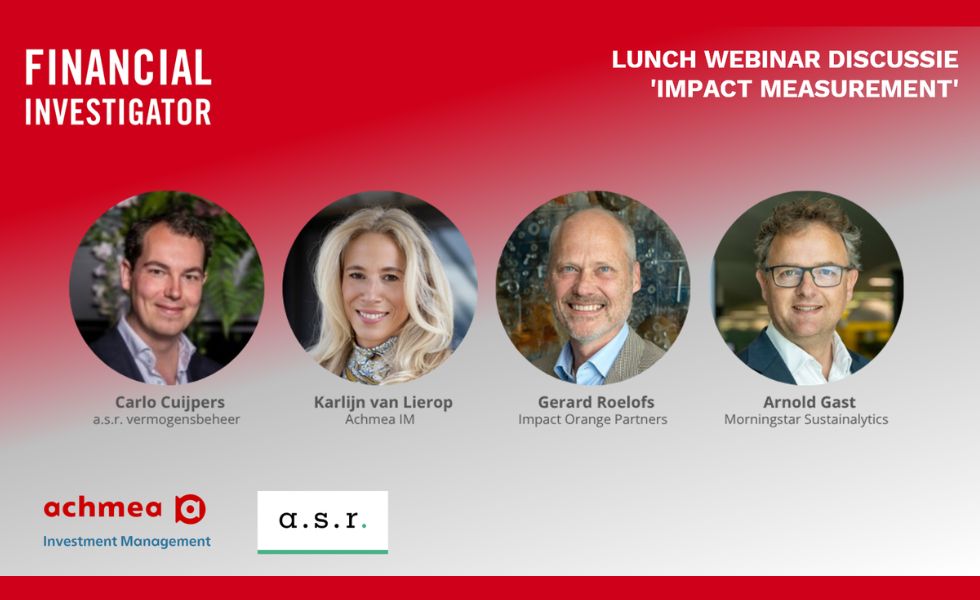
Chair Arnold Gast, Morningstar Sustainalytics Participants Carlo Cuijpers, a.s.r. vermogensbeheer Karlijn van Lierop, Achmea Investment Management Gerard Roelofs, Impact Orange Partners |
At the start of the webinar, moderator Arnold Gast emphasised the importance of a clear definition of impact investing. ‘That prevents superficial claims.’ The webinar is guided by the definition provided by the Global Impact Investing Network (GIIN): striving for positive social and environmental impact alongside financial returns. This is underpinned by three key concepts: intentionality, additionality and measurability. ‘If you follow the logic of intentionality and additionality, you naturally arrive at the concrete measurement of outcomes,’ says Gast.
For Karlijn van Lierop, intentionality is the essential starting point. ‘You must explicitly determine at the outset which social problem you want to tackle. If you are not consciously aware of where you want to make a difference, it is also very difficult to subsequently determine which concrete results have been achieved.’ Intentionality is therefore the core, she argues. ‘It forms part of our investments and our search process, and it is central when we appoint an external manager.’
According to Van Lierop, explicitly defining objectives in advance determines what becomes measurable later on. ‘That makes it much easier to assess how we can monitor those objectives and which metrics are important in that regard.’ For Carlo Cuijpers, too, intentionality forms the basis. ‘We assess intentionality by examining whether potential investments have a credible “theory of change”, which clearly sets out how they will create positive social or environmental outcomes.’ In his view, its role goes beyond mere conceptual thinking. ‘For us, such a theory of change plays a similar role to, for example, a balance sheet or annual accounts when assessing the business case for an investment.’ A good theory of change therefore provides guidance not only when selecting investments in advance, but also during subsequent evaluation. ‘It allows you to look back at what you had in mind beforehand and assess whether you are satisfied with the outcome, and whether you might wish to do even more.’
The experts emphasise that measuring impact does not start with data, but with clearly articulating the desired change. Only once that is clear can relevant KPIs be formulated. Van Lierop describes how measurability operates at multiple levels: at pension fund level, at fund level, and at company level. ‘At each level, you can assess whether there is impact performance.’ She cites several reasons why this is important: ‘Firstly, for monitoring purposes, and secondly, for accountability and transparency. You want to see whether the impact manager is actually delivering what was agreed. And it is important to explain to pension scheme members what impact investing means in concrete terms and what benefits it brings.’
Gerard Roelofs adds, drawing on his consultancy experience, that impact ambitions always begin with a consultation with members, alongside discussions with the board and the investment committee. Part of the discussion is how far the impact should extend: ‘impact first’ or ‘impact aligned’? ‘But,’ he notes, ‘ambitions must also be investable. If you cannot invest, it remains a theoretical exercise. ’
That theory becomes tangible through concrete investments. Van Lierop cites a wind farm in Norway as an example, where not only the amount of renewable energy generated and the capacity are measured, but also the proportional share of the fund’s own investment.
Cuijpers cites an investment in a fund comprising various companies, each of which contributes in a different way to a more regenerative food system. ‘For every investment within the fund, the theory of change is very clear, and you can therefore measure it unambiguously by looking at the reduction in food waste in tonnes or at the amount of chemical pesticides saved.’
Roelofs talks about a farm in Portugal that received an investment to help it transition to regenerative agriculture. He explains that a regeneration plan enabled the farm to actively work towards pre-defined goals. ‘Less water was used, less artificial fertiliser was applied, and soil quality improved. At the same time, production levels remained stable.’ As far as he is concerned, this shows that measuring impact does not necessarily lead to a loss of output and returns.
Fewer KPIs, more quality
A recurring theme during the webinar was the question of how many KPIs are actually needed to measure impact effectively. According to Van Lierop, the focus is too often on numbers. ‘It’s not so much about the number of KPIs, but about what is appropriate. Which KPI really relates to the core activity of your investment? Quality over quantity.’ Roelofs agrees. ‘I see plenty of reports listing hundreds of KPIs, yet ultimately hardly any consequences are attached to whether or not a particular target is met. ‘It’s better to have slightly fewer KPIs – properly aggregated and easy to communicate – than too many,’ he adds. For Cuijpers, it can even arouse suspicion if a manager produces a huge number of data points. He argues that, as a manager, you must choose the KPIs you can genuinely stand behind. ‘The chain can sometimes be quite long. Take a private equity firm with a particular fund comprising all sorts of companies, each of which in turn has several projects. Parties must be able to take responsibility for the data at every stage of that chain.’
Data quality, however, remains a challenge. Although standards such as the GIIN framework and IRIS+ are being applied more widely, the panellists still identify significant shortcomings. Cuijpers cites responsibility for data quality as a key area of concern. Attribution – the correct attribution of impact to investors – is also a bottleneck. ‘You often see parties double-counting impact, or including the total without applying any form of attribution.’ He does, however, see positive developments. PCAF, the Partnership for Carbon Accounting Financials, has largely resolved the issue of attribution for the measurement and allocation of climate impact. ‘That part could simply be copied and pasted into other standards,’ says Cuijpers.
According to Van Lierop, developments in the climate field have now progressed relatively far, but the social sector in particular is lagging behind. ‘Progress is being made on biodiversity. There are also initiatives regarding the availability and quality of data for health and equality of opportunity. For example, our organisation has contributed to LIFe, the Lifesciences and Healthcare Impact Framework.’
Roelofs also points to another problem: the fragmentation of data providers. ‘The quality of data and its cost remain a challenge. Sometimes a provider suddenly disappears from the market, even though their data forms part of your reporting process.’ Gast concludes that the continuity and quality of data remain complex issues.
‘And this at a time when creating data has become so easy,’ he adds. Roelofs concludes: ‘Yes, data seems to be available everywhere, but the question remains: is it actually information?’
|
SUMMARY A clear definition of impact investing prevents superficial claims. Intentionality, additionality and measurability are central to this. Measuring impact begins with pre-defined social objectives and a credible theory of change. KPIs must align with the core of the investment. Quality takes precedence over quantity. Data quality, attribution and the fragmentation of data providers remain significant challenges. |
Read the full report in the online magazine