
PIMCO: Growth holds, risks widen

In a world where the central scenario is benign but the tail risks are fat, investors should look to build portfolios that can be resilient across a variety of scenarios.
By Tiffany Wilding, Economist, and Andrew Balls, CIO Global Fixed Income, both at PIMCO
This year, the conflict in the Middle East sparked a new inflation shock that has lifted yields further. Today’s higher yields may provide income that can help offset price declines to a degree that was not possible in 2022. Still, the path higher has been challenging for investors.
To understand where yields may go from here, it is useful to examine why they have risen. Several forces have contributed, some more than others:
- Higher energy prices, and their impact on monetary policy expectations, have been the main driver pushing real yields higher.
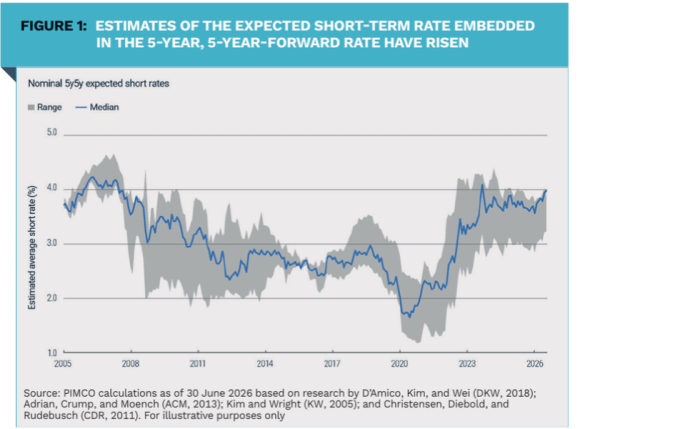
- Real yields reflect two components: the real neutral rate, which has risen, and the term premium, which has not.
- Fiscal concerns have not been a significant driver of the recent rise in yields.
- The scale of corporate debt issuance tied to the AI buildout may be a contributing factor.
Looking ahead, our baseline is that central banks will remain credibly committed to taming inflation. That can provide a supportive framework for bonds by helping reduce investor uncertainty around the medium-term outlook for yields. Ultimately, this can help restore the negative correlation between bonds and equities that makes duration an effective portfolio hedge. Such negative correlations tend to reassert themselves over time.
Today, investors are being compensated for higher neutral rates. Starting yields – historically highly correlated with five-year forward returns –make bonds a potentially attractive income-generating asset, while at the same time being a potentially effective hedge against a more uncertain outlook.
Even after the recent rise, bond yields are back near their long-run historical averages – levels last seen in the 1990s and early 2000s, before the era of suppressed yields that followed the global financial crisis. While real yields could still rise further, today’s levels provide income that can be supportive across a range of scenarios. Fixed income does not need yields to decline to be able to generate strong absolute and relative returns, but there are also bullish scenarios if yields do fall – for example, if AI-driven disinflation were to materialize.
How to build portfolio resilience
In a world where the central scenario is benign but the tail risks are fat, investors should look to build portfolios that can be resilient across a variety of scenarios.
1) Own a diversified, global portfolio of high-quality duration
Attractive starting yields – and the income they can offer – provide a meaningful mitigant against inflationary tail risks while preserving the potential for bonds to hedge a fading AI capex impulse or a shock to growth. A global bond allocation across DM and EM can help diversify country-specific factors, including fiscal risks.
We seek to be flexible in credit allocations, using relative value as a guide across sectors. We are still finding attractive value in real asset finance and asset based lending
Data show households may remain overallocated to equities and to cash relative to history and underallocated to bonds, even though bond yields today may be comparable with equity earnings yields.
2) Be selective within credit and the AI complex
The AI buildout is at the heart of the investment opportunity in credit. Much of the AI capital spending forecast has been pulled forward into the cyclical horizon. That said, credit spreads are tight, and AI-related correlations are rising as more debt gets issued in the sector.
We focus on selectivity, relative value, and downside mitigation, aiming to ensure adequate risk compensation. In AI-related credit, that can mean seeking more compensation for regulatory and legal risks and politics tied to the U.S. midterm elections.
At a time of AI disruption, diversification is increasingly important. Investors should be open-minded about what sectors could get disrupted. Software is an obvious candidate, but the possibilities are more widespread, and companies that lag in the AI implemen tation race are at risk of being left behind. In some areas, heightened AI-enabled competition may not drive companies out of business, but it could pressure margins.
At a time of AI disruption, diversification is increasingly important. Investors should be open minded about what sectors could get disrupted
Higher interest rates will affect a credit default cycle that was already well underway. In corporate direct lending, investors face disappointment relative to returns of recent years. The impact could be magnified for some of the most ratings- and liquidity-constrained vehicles that were largely constructed for benign credit and rate environments. Many such vehicles have exhibited significant growth in recent years and now face challenges from both higher rates and credit deterioration.
We seek to be flexible in credit allocations, using relative value as a guide across sectors. We are still finding attractive value in real asset finance and asset-based lending, even as recent outperformance has caused the relative valuation advantage to narrow in some areas.
3) Consider commodities and real assets to hedge supply-side risks
In an era of more frequent geopolitical, energy, and other supply shocks, portfolios need mitigation against outcomes in which inflation rises even as growth weakens. Commodities and select real assets can complement duration by providing exposure to the very scarcity and supply pressures that could challenge both economic growth and conventional financial assets.
Conclusion
The baseline for this cycle remains constructive. But part of that resilience relies on an investment boom driven by an unusual combination of commercial opportunity and strategic urgency, and one that could be proceeding faster than the guardrails around it. That combination creates potential upside for productivity and growth, but it also produces unusually fat tail risks.
In our view, portfolios should be positioned to participate in the baseline and withstand those tails. At today’s starting yields, that remains a powerful argument for bonds.
|
SUMMARY Higher energy prices and inflation expectations have driven bond yields higher, while fiscal concerns have played a limited role. Attractive starting yields make bonds a potentially compelling source of income and portfolio diversification. Global diversification across high-quality bonds can help mitigate country-specific risks. Selectivity in credit is essential as AI-related debt issuance increases and credit spreads remain tight. Commodities and real assets can provide protection against geopolitical and inflationary shocks. Resilient portfolios must balance growth opportunities with substantial tail risks. |